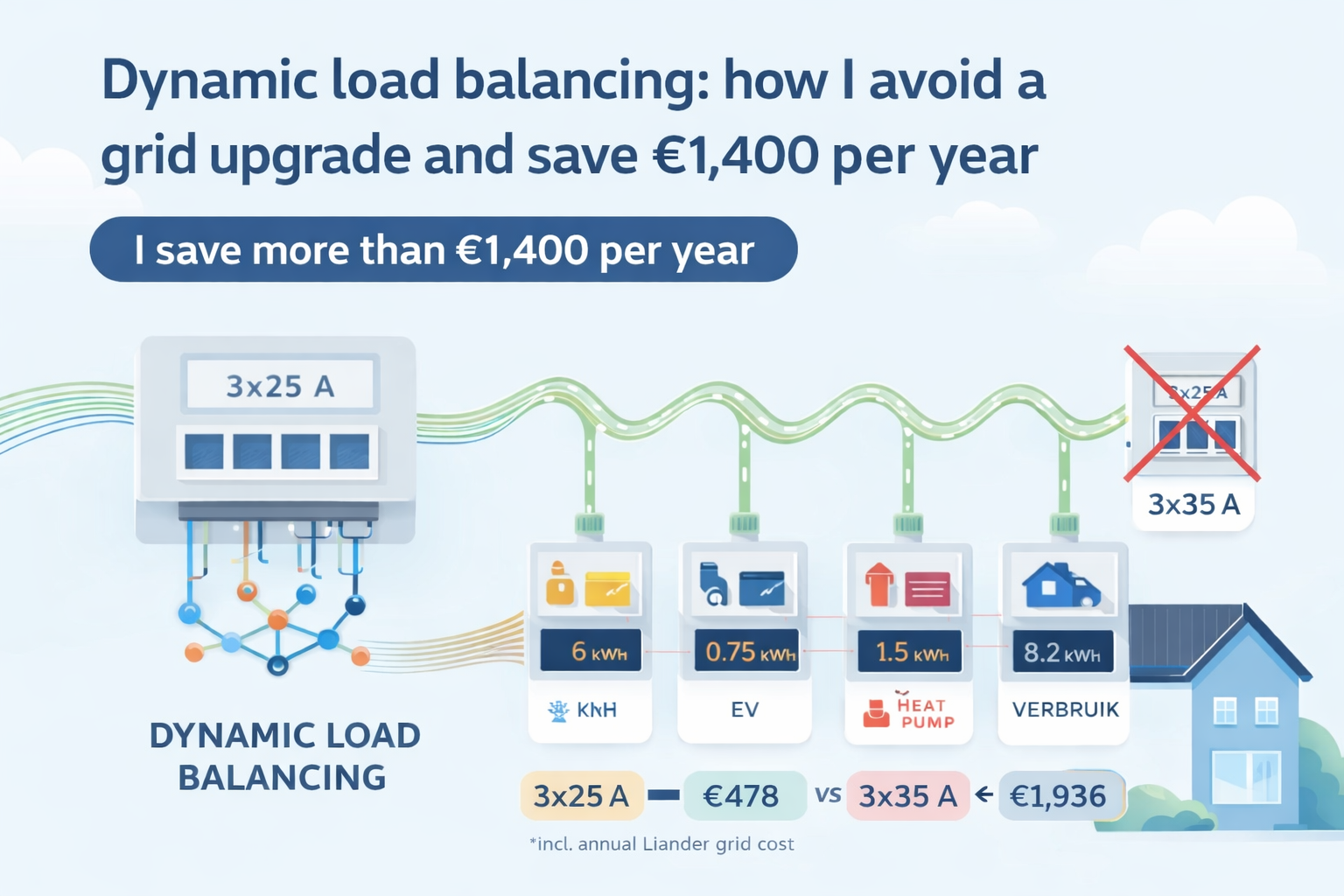
Dynamic Load Balancing
Dynamic Load Balancing: How I Avoid a Grid Upgrade and Save €1,400 per Year
Introduction
With the rapid electrification of homes—think solar panels, heat pumps, home batteries and EV chargers—many households are running into the same problem: their electricity connection is no longer sufficient.
A common solution is to upgrade the grid connection. But that comes at a steep and recurring cost.
In this article, I explain how dynamic load balancing allows me to keep my 3×25A connection, avoid a costly grid upgrade, and save more than €1,400 per year—based on real-life data from my own installation using the Maxem Energy Controller.
What Is Dynamic Load Balancing?
Dynamic load balancing is smart energy management software that continuously monitors the total electricity load of your home and actively adjusts large consumers when needed.
In my case, Maxem receives real-time data from:
- Solar panels
- Home battery
- Heat pump
- EV charger
- Total household consumption
If the total power demand approaches the maximum capacity of my grid connection, Maxem automatically reduces or temporarily pauses certain loads—most notably the EV charger.
The result:
👉 Peak overloads? NO!
👉 Blown main fuses? NO!
👉 Heavier grid connection? NO!
Why Grid Upgrades Are Becoming a Real Issue
In the Netherlands, many homes still have a 3×25A electricity connection. That used to be more than enough.
But today, a modern electric household can easily exceed that limit when:
- The heat pump is running
- The EV is charging
- The home battery is charging or discharging
- Household appliances are in use
Without load balancing, simultaneous peaks can force homeowners to upgrade to 3×35A or even higher.
The Real Costs of a Grid Connection Upgrade
Here are the actual annual costs (including VAT) charged by grid operator Liander:
| Connection | Annual cost |
| 3×25A | €478.04 |
| 3×35A | €1,936.14 |
That’s a difference of:
€1,458.10 per year
And this is not a one-time cost—it increases with inflation and applies every single year.
What Does Dynamic Load Balancing Cost?
I pay:
- €65.70 per year for Maxem
That’s it.
The Net Financial Benefit
Let’s do the math:
- Avoided grid upgrade: €1,458.10
- Maxem subscription: – €65.70
👉 Net annual saving:
€1,392.40
That is a return on investment of more than 2,000%.
Do I Actually Need Dynamic Load Balancing?
Based on my installation: yes, absolutely.
Even with:
- Solar panels producing energy during the day
- A home battery buffering part of the load
There are still moments—especially in winter or in the evening—when:
- The heat pump runs at high capacity
- The EV starts charging
- Household demand is already elevated
Without dynamic load balancing, these combined loads would regularly exceed the limits of a 3×25A connection.
Dynamic load balancing doesn’t reduce comfort:
- The car still charges (just smarter)
- The heat pump keeps running
- The household never notices
Dynamic Load Balancing vs. Grid Upgrade
| Aspect | Dynamic Load Balancing | Grid Upgrade |
| Upfront cost | Low | High |
| Annual cost | ~€66 | ~€1,936 |
| Smart control | Yes | No |
| Future-proof | Yes | Limited |
| CO₂ impact | Lower | Higher |
Why This Matters for Energy Transition
As grid congestion becomes a serious issue, solutions like dynamic load balancing:
- Reduce pressure on the electricity grid
- Delay expensive infrastructure upgrades
- Enable more households to electrify sustainably
In other words: this is not just cheaper—it’s smarter energy use.
Conclusion: A No-Brainer for Electrified Homes
If your home has:
- A heat pump
- An EV charger
- Solar panels
- A home battery
Then dynamic load balancing is not a luxury—it’s essential.
For me, it:
- Prevents a grid upgrade
- Saves nearly €1,400 per year
- Runs fully automatically in the background
And perhaps most importantly:
👉 It lets me future-proof my home without paying the grid operator a fortune.